
Adult Nautical Romantasy Novel
Captain Delfin Caravello is known as the Devil of Sunken Isles, originating from one of the last places where Nature’s magic still runs wild. Hardened by loss and drowning in guilt, Del has survived by refusing attachment–until his world collides with Ruby’s and she becomes integral to the voyage to rescue his long lost brother, his only remaining family. As Del guides Ruby into this unknown power, desire grows alongside trust and threatens the walls he built to endure.
Valadier Caravello was once a frail, literary boy born with a congenital spinal deformity, disowned by his pirate captain father and sold into slavery on the unmapped island of Driarwrake. Power remade him into something feared: a ruthless duke who believes tyranny is the only defense against suffering and that intellect confers supremacy. When he learns that the missing piece to his final ascension is a girl whom the sea has endowed with a gift, he offers her a crown, answers, and a world where nothing can hurt her ever again.
As the sea draws them together, prophecy reveals itself as choice rather than chance machination. Ruby must decide whether to embrace power without losing herself, Del must contend with loss and risk the love he never intended to know, and Valadier tightens his grip on dominion, thereby setting the stage for a future reckoning that will not end with mercy.

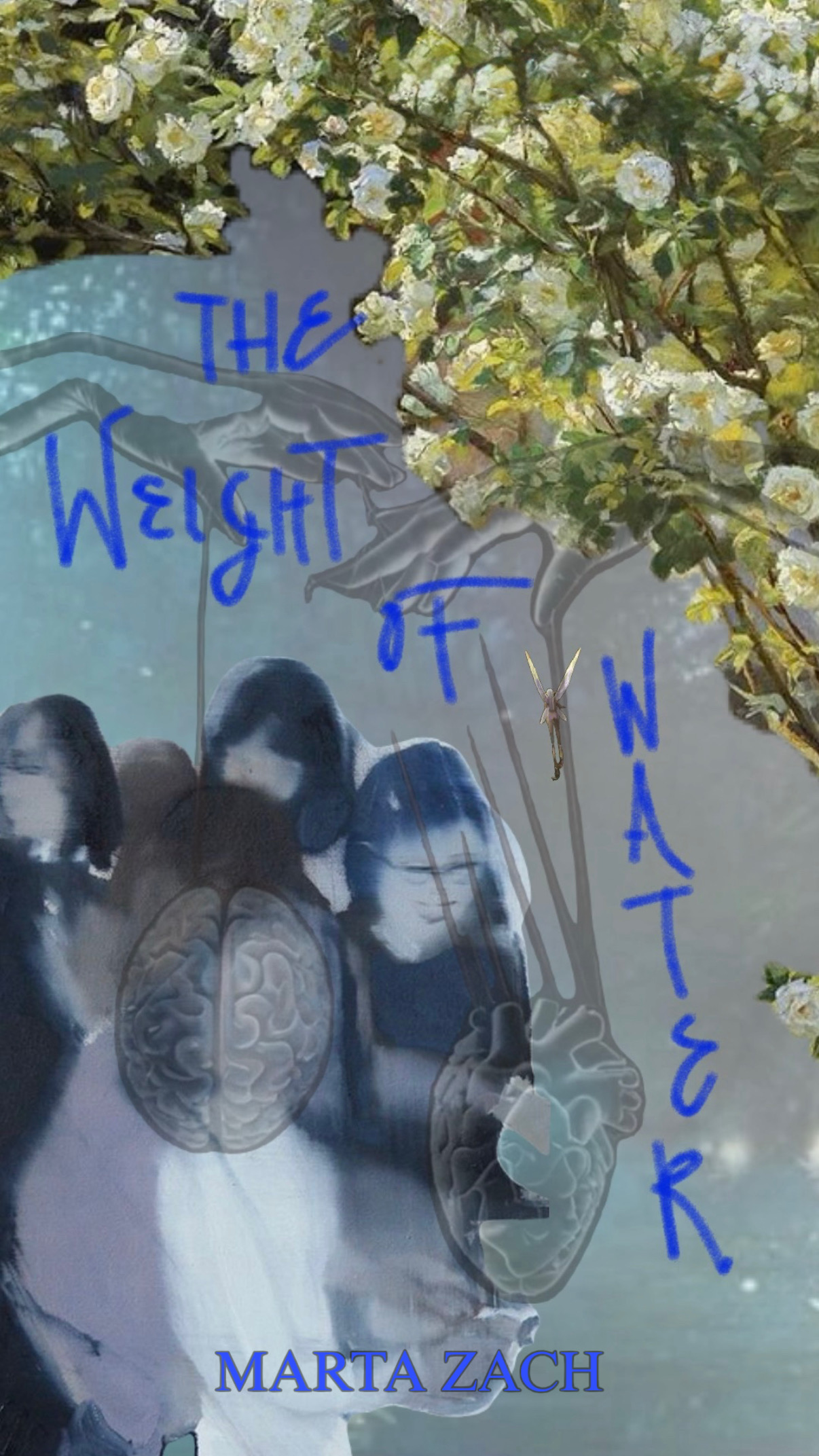
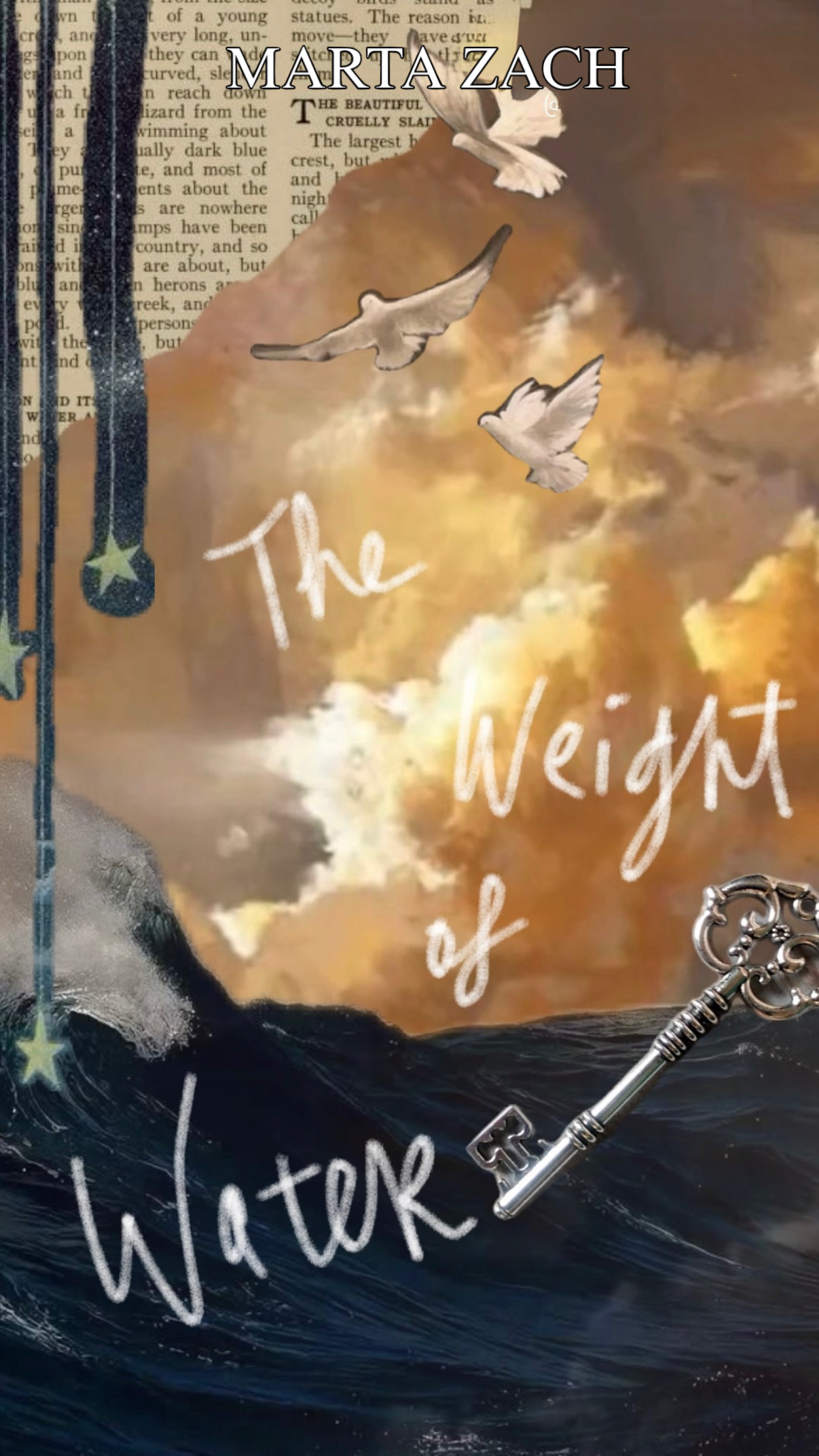
Note: I created every cover’s collage and wrote the title, but all pictures and art are from Pinterest
The earliest seeds for The Weight of Water began to sprout in 2023, when I wrote in my notes app: Pirate and Ballerina. I imagined a sprightly and adroit pirate and a lithe dancer, a union between heights of virility, a contrast between a wild world and one of order and refinement. In 2024, I made a secret Pinterest board called “brewing book,” where I would pin reminders of ships, the fantastical and the nautical, and characters resembling the cast I envisioned in my head.
The polarities between Western and Eastern ideologies became increasingly fascinating to me the more I studied spirituality, occultism, and even fictional literature, and continue to inform the rabbit holes that I go down as well as my own musings. I wished for the two main characters (who serve as our love interests) to explore antipodal frames of thought and ways of being in order to illustrate the differences between an industrialized and organized world and its foil: a world in leagues with Nature, intuitive, and deeply spiritual.
He strode over to the center of the room, away from the large armoire by the wall, and turned to her and said: “I am a pirate who forged my way into this wedding and I am now robbing your palace.”
Her eyes widened, but she felt no impulse to scream or back away. For a fleeting second, she thought this stranger must be deceiving her. He must have gotten lost and was embarrassed to admit the truth. But as she looked on into his eyes, intelligent behind the thick white powder caking around them, she could detect an aptitude that would not permit for a trite getting lost in spite of the foolishness of his exterior.
“What would happen if I called for help right now?” She pressed. But she knew she would not do so.
“You wouldn’t.” He smiled. He was reading her like a book.
“What makes you say so?”
He stepped closer. There was a thin gold hoop in one of his ears. “You just told me you are dreading your wedding. This reeks of a word I’m sure we are both familiar with—arranged. I highly doubt that you are a fan of anyone upon these grounds right now.”
How right he was. “You’re too sharp to be robbing castles.”
“I am too sharp not to rob castles.”
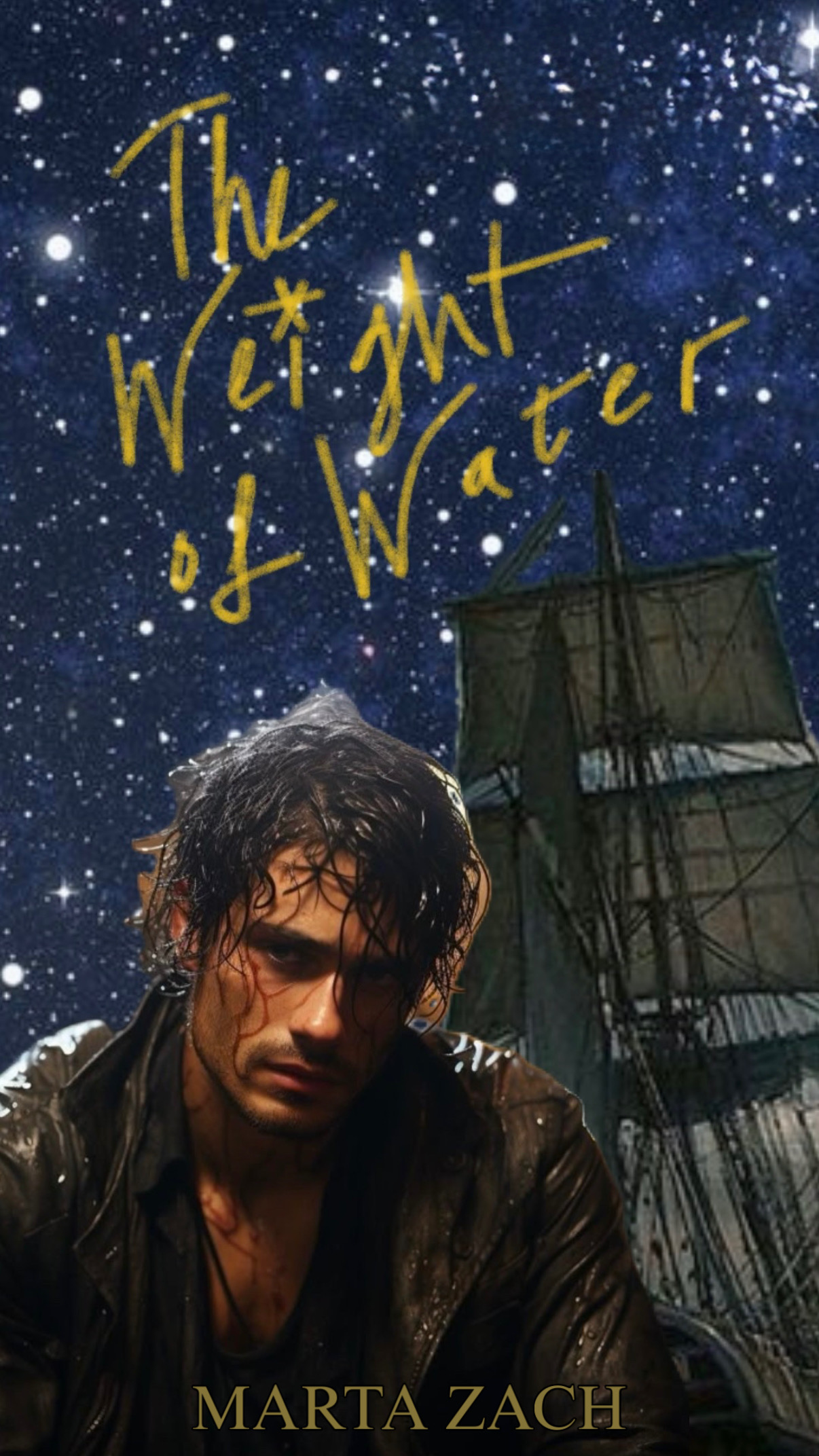
Delfin Caravello was largely inspired by Jack Sparrow and Howl from Howl’s Moving Castle. Ruby Dufourmantelle was inspired by Anne Shirley, whose loquaciousness never failed to charm me. I sought to make Ruby strong and competent as a result of her overwhelming femininity and gentleness, rather than in spite of it.

Spoiler: I intend to make this a series with a love traingle. The Weight of Water was the lighter, more charming installment of the series, though I admit that the ending is rather devastating. As per the Harry Potter series model I was acquainted with at eight years old when I first read the series, my own plots become darker and more intense as the series goes on.
In his youthful, naive optimism, which was with each day dwindling away into nothingness, he would have liked to think that the audience was not celebrating any individual demise or glory, but rather, the fact that they themselves were not in the ring. Foreign people brought here as slaves were the ultimate scapegoats for an impoverished populace who likely found solace in the fact that there was someone in a lower caste than they were. It was not their sons’ fight to live; it was not their daughters’ bodies being sold. Maybe it was not man versus man that they’d come to watch—perhaps it was their own dwindling misfortune. Class degradation and destitute circumstance did not allow for upward looks to attainable dreams or ascension to liberation; instead, one could only hope not to be the most damned of all.
The damned were now a few paces away from one another, eye-to-eye.
“Valadier Caravello.”
“Ira D’Ingo.”
Val looked on at this boy—not a friend, but not a foe, either. The boy was scared, too, but scared animals fought the hardest.
In the book of the law, this would have been resolved with reason and the camaraderie of sense. Human judgement would perservere as it logically ought to and they would refute the animalistic barbarianism that they’d been thrust into.
But there was no law on this island. What this was instead was an infinitely greater travesty than anything that took place in the animal kingdom, for at least animals killed only to live. Creatures of limited faculties and conscientousness did not possess the capacity for sport. To live in black-and-white was to live unencumbered. Where the human race had self-selected itself to wield dominion over the animal kingdom, borne of an instinct of superiority and grandeur, what this supposed humanity instead did was assume the insipid role of being inferior to that which it sought to conquer.
In his books of dignity, intellect, and jurisprudence, they would have reached a mutual agreement upon this battlefield. They would have stepped toward one another with sensibility and reason and they would have risen above the less-than-animals that they were surrounded by. They would have refused to partake in this convoluted game. They would be proper men. They would establish that no ruse put forth by their tormentors would move them and they would shake on it and honor it.
Neither of us will attack the other. They will watch nothing. They will rot in their seats.
But there was no such law in the arena. The boy across from him would immediately charge at Val if he tried to approach him. Val would most definitely be threatened by any of the boy’s advances. Any appeals to reason would be dismissed as a distraction and a gambit.
Thus was the swordslinger’s dilemma: the one who relented first would be the first to go down. And this was the only law that existed: kill or be killed.
THE WEIGHT OF WATER will appeal to the readers of One Dark Window and The Wolf and the Woodsman for its emotionally driven and seasoned romance arc, Emily Wilde’s Encyclopedia of Faeries for its wit and charm, and The Bear and the Nightingale for its lyricism and fairytale notes.

I’m excited for you all to enter this world I’ve created 🙂
“It is like cutting through butter. Our mind preemptively curtails violence. But it is easy. It is natural.”
His fingers traveled to the lamb’s ribbed throat. It bleated once, its little cry. Its ears flew back. This creature was unaware that it had no autonomy in this world, that its cries did not matter, that it was destined to be crushed. It looked on and saw darkness and smelled fire and bleated and bleated, announcing its animal sensations, its voice falling on deaf ears.
“Ah,” the Duke said, cutting through Val’s nervous contemplation. “You are just a boy. Boys do not do these savage things. Boys spare lambs. And then they get ravaged by the cruel world in which lambs are spared, for that is the law that they have chosen to live by.”
The powerful shadow that had risen behind the Duke was falling. That massive wolf began to shrink as he called it back.
“Eat, or be eaten, boy.” He stepped closer. The lamb twitched in Val’s lap. It began to cower, then to stretch its legs to flee as he advanced. “But alas,” The Duke looked at Valadier. This was it. This was his chance and he was weak and pathetic.
The Duke’s commanding tone slowly melted into a disdainful revulsion: “Some creatures are destined to be eaten.”
He began to exit the circle. The energy pulsating about them waned. The ritual would come to a close and it would all be over.
The lamb screamed unlike he’d ever heard anything scream before as his teeth sank into its throat. Valadier gripped its small form in his hands and craned his neck down like a feeding beast to tear into its body. He closed his eyes and pictured meals of days past and forced his teeth to clamp down, to gnash, to tear.
“Oh yes,” The Duke said excitedly, drawing his hands together. The wolf behind him began to rise up once more. “The birth of Lupus. I had not been mistaken.”
“Luto Luto Luto. Esworo. Luto Luto Luto. Esoto moredre luto esworo.”
The women were now standing, stomping their feet, dancing around the fire, pounding upon the drums. She-wolves rose up behind them and danced, side by side, all around the cavern walls.
Valadier had never known such acute torment. One of the lamb heads had gone silent but its twin continued to scream, its tongue flailing about, eyes wide.
His tears mixed with the blood and streamed down his chin onto his clothes and the cave floor. Exasperated wails brewed in the pit of his stomach and he sobbed into the lamb’s exposed throat. Valadier fought the wracking cries and kept his head down so that the Duke would not see. Fragile and helpless. Wool caught in his teeth and he suppressed the throat-clamping gags bubbling up in his esophagus, roiling through his entire body, until he no longer could withhold the bile spurting into his mouth. The hot, hot blood poured down his throat, foul and bitter, and chunks of shredded coat and warm meat churned in his mouth.
“Luto Luto Luto. Esworo. Luto Luto Luto.” The chanting grew louder, more frenzied.
“Eat!” The Duke shouted. “Drink its blood and know the appetite for destruction.”
It took everything in Valadier not to retch upon the floor and abandon the task entirely. He forced himself to tear into the throat once again. The other head’s screams had faded and it hung limply with its twin. The body had gone slack. Valadier’s tunic was soaked with blood.
“Luto Luto Luto. Esworo. Luto Luto Luto. Esoto moredre luto esworo.”
He felt a form towering over him. But it was not the Duke, who stood straight ahead and watched approvingly. It was not any of the women, who remained chanting and beating upon the drums. It was something else entirely, something that had not been there before. He turned and saw the wolf-form rising up behind him, with its two slits for eyes and massive shoulders raised.
“Luto Luto Luto. Esworo. Luto Luto Luto. Esoto moredre luto esworo.”
Eat.
The force lingering behind him crept closer and closer until he could feel himself becoming imbued with its energy. He expected sheer brutality upon this invasion, but the spirit was wiser than that. Val was invigorated.
“You’re going to lose your soul,” the women chanted.
He and the wolf tore into the body. They chewed the bones to bits. They drank all the blood. And the Valadier who had hesitated now seemed an artifact of a distant, forgotten past. His new heart beat rapaciously and the world made sense once more.
CHAPTER ONE
Ruby Intro – cut from novel
Desperation was a very particular force in the way that it made heroes out of cowards—or cowards out of heroes.
Rolling booms of thunder animated the dark night sky. Torrential rain poured down ceaselessly, pooling in cobblestone cracks and sliding down the castle walls like a series of waterfalls. The castle’s dark granite walls extended into that menacing black sky and stood solemnly, slick with rain, tearful and morbid. These rising columns had weathered many a storm and and remained unmoved by Nature’s formidable display. All souls were soundly asleep within those castle walls, safeguarded from the ominous night. Thunderclaps would not infiltrate any of tonight’s dreams.
But there was no sleep to be had for her tonight. Dreams were reserved for the dutiful, the good, the acquiesent.
She hurried down a series of stone steps, lifting her skirts as to not slip and fall. Her soaked clothes clung to her chilled skin and puddles formed in her leather riding boots. Her heart was threatening to tear open her bodice and fling itself from her body.
She reached the base of the stairs and fled across the courtyard, the hood of her coat pulled over her face as a deflection against the rain and any watchful eyes for whom slumber did not come. The former was a lost cause—her sopping wet hair was a thick, heavy rope against her back and her skin was gooseflesh. As for the latter potentiality, she could only hope that her face was obscured. Her greatest hope was that she would remain entirely unseen. This was not a hope—it was a must; a variable she could not afford to gamble.
She’d made it across the grass and threw herself against the wall, chest heaving. She looked up at the tower from which she’d just emerged—black spire jutting upward, an amalgmation of all the stern eyes that rested within it, oblivious to her escapade.
Her mother and father were laying wrapped up in their gossamer silk sheets. Rollo was at the foot of their bed, obsessed with her father as he was. She thought of her mother’s pretty sleep gown and how it billowed as a curtain ruffled by a spring breeze whenever her mother would come into her room as she did every night, before bed, to bid her a goodnight.
This night had been no different. She’d been lying in bed, feigning drowsiness while she breathed in the fresh summer lavender in the vase by her bed and thought of how she’d never sleep in her bed ever again.
The castle was a divine marvel, sitting in the middle of an infinitisemal sprawl of rolling acres, clusters of beeches, oaks, and cherry trees, dotted with creeks and ponds. She spent every season of her life on the grounds—frolicking through the fields in the summer, barefoot, the garden’s riches braided into her golden chestnut hair; gathering applecrisps with chilled fall air nipping delightfully at her exposed skin; dashing across the wintry frozen pond and scooping up the syrup she’d poured into the snow, rolling it around her finger; admiring spring’s babies in their nests and riding bareback through the cherry blossoms in breezy dresses.
She spoke to nature and it spoke back. The familiar grounds whispered her name. She and the outside world had a particular mutual camaraderie that she’d once made vain attempts to explain to her parents when she was a little girl, to no avail, and had not tried since. Animals did not dash away from her as they did from others, startled and wide-eyed. When she laid in the grass, she felt as though the earth were embracing her and whispering secrets to her. But there was no way for her to capture or make sense of this all. There were no books in the castle’s library that explained these phenomena—they were out of reach, even for her, as they occurred. She attributed these sensations to her overactively creative mind. As she grew older, their intensity faded, and her time outside was fun and lovely as it would be for any person wired for earthly endeavors and natural bounties: it was normal.
These thoughts were all running through her mind when the door had gently creaked open and her mother had peeked in.
“Goodnight, my darling,” she had said, as she always did.
“Goodnight,” she’d said back, hoarsely. Her chest had constricted and she’d fought back tears as her mother smiled softly and sleepily and closed the door. Those footsteps, getting quieter and quieter as she walked away, would haunt her.
This past summer, warm and languid, her final at home, was a complete antithesis to the virulent vortex of a storm that she had stepped out into. She wished she didn’t have to endure the brutal rain and that lighting weren’t creeping up on her, sporadically illuminating the night in bright flashes, but she could wait no longer. She had to go now, and the storm would provide extra cover. She’d made up her mind and if she waited any longer she’d be a prisoner to the circumstances that awaited her. If she did not go tonight, she feared that she would keep putting it off until the possibility would escape her.
As she had been leaving, she’d dared to sneak down the corridor to get one last look at her parents. She watched as they laid peacefully, their chests rising and falling with nocturnal, even breaths.
She loved them so much. Where the outdoors was a limitless beyond, the castle was a warm embrace filled to the brim with her parents’ affection.
So why are you doing this to me? She thought, blinking back tears.
Rollo had stirred then, lifting his brown head and gazing at her with big round black eyes. She loved him so much, too. She remembered him as a puppy—a bundle of unfaltering energy and joy that had a particular affinity for jumping into laps and bestowing kisses.
What are you thinking, Rollo?
She couldn’t say anything to him, for fear of waking her parents, so she merely stepped back wordlessly.
She’d shut the door wondering if she’d ever get to see all of their faces ever again.
Rollo was getting old—his snout was slowly becoming grey and the once wired limbs were losing their youthful animal vitality. Her parents were getting old, too. Their hands betrayed this the most. She tended to notice hands and the passion they conveyed—the way they held and grasped and brushed and gesticulated. And hands aged first.
She forced the thoughts from her head, otherwise she’d start sobbing. If she kept thinking about it all, she might just stay. And she could not afford to recant the promise she’d made to herself. A person who defied themselves pillaged their innermost integrity and became a puppet of fleeting circumstance.
Now she was against a cold stone wall, prying herself away from the life she’d always known with each step she took from her room and all of the familiarity within the castle; her home.
She stayed against the wall as she moved toward the door that led out to the stables. She had to be careful, for a pair of sentries was positioned on the battlement above the large wooden gates that separated their sleeping chambers from the other part of the castle. She’d have to remain as close to the wall as possible. It was a doable feat—the exposed corridors were obstructed by the night. She felt a pang of gratitude for the downpour that was obscuring her movements and noise. The guards were on the lookout for anything coming in—they wouldn’t be expecting her, nor would they be looking at the passageways that framed the courtyard.
The big wooden gate was bolted shut and would make for the most conspicuous exit imaginable. The guards were there to patrol that very entrance. She’d have to use the smaller door to the left, at the end of the open corridor through which she was traversing. If she did this with enough agility, she could sneak through it and disappear around the corner and make her way toward the stables.
The guards paced back and forth. She wished they would deem it too cold and wet and retire inside, but they were governed by a loyalty that strengthened with duration of servitude, which was then reinforced by a sizable salary.
One of the guards suddenly turned around, to his left, peering out toward the corridor through which she was making her way. She gasped and flung herself against the wall. Her heart pounded fiercely.
Her parents would lock her up and she’d never get the chance to escape again. It was now or never and she could not allow this chance to slip through her fingers. Otherwise, she’d live, but her life would be ruined.
The guard continued peering over. She prayed lightning would not strike.
Can he see me?
The not knowing ate away at her. What was he doing? Was he seeing if she’d flee? She remained frozen.
He then turned around and resumed absentmindedly pacing up and down the strip of battlement. He hadn’t seen her, and the other guard had not, either. They were too far away and she was but a small speck darting through the night.
She continued creeping ahead, against the wall, until she reached the small wooden door. She slid open the bolt and jammed into it with her shoulder.
It didn’t budge.
She pressed her body into it and dug her heels into the stone floor and pushed with her upper back, but that was to no avail. The door remained closed.
It is locked from the outside? The panicked thought rose up inside of her. Since when was that ever done? She’d always had free access to the stables and to the rest of the castle and its grounds.
Did her parents know she was actually going to leave?
These past few months had been rigid and wry. Tension was palpable and the tender and docile relationship she had with her parents was hallmarked by terse moments riddled with resentment that would have metamorphosed into hatred if she were any less loving. Her little rebellions included silent dinners, or skipping them altogether. She’d refuse walks with her parents and she’d spend entire days riding Chessy and picnicking out by the oaks to avoid being inside with them. They’d sigh, and they would try to talk to her, and they would come into her room with offers that, while appealing on their own, would never ameliorate what they had done and what they were doing to her. She wished she had the capacity to scream and rage, but anger was an emotion she seemingly did not have the capacity for. She didn’t believe in anger—how could anyone conjure up such fiery and brutalistic red within themselves? The closest she ever came to anger was extreme annoyance or profound sadness.
But there was no way they expected her to ever leave this darling familiarity. That had to be the case. She wasn’t sure if she could navigate her way out of here if this familiarity had been reinforced with precautions against her escape.
She clenched her jaw and turned around once more and pummeled into the hard wood of the door. This time it flung open and she nearly fell out on the other side. She steadied herself on wobbly, unsure feet.
It hadn’t been locked; just stuck. While she did not appreciate the bruise that would most definitely form on her shoulder and her near-tumble onto muddy earth, she was relieved that her escape weren’t being thwarted by externalities and that it was more likely than not that her parents were blissfully unaware of the extent of her devastation.
She rushed to close the door and didn’t even look to see if the guards had seen her before slipping around the corner and sprinting toward the stables.
She was a soaked, panting mess when she came barreling into the dark, peaceful stillness of the stables.
Her beloved Chester was waiting for her as they’d agreed upon the day before. Chester was an angel-Appaloosa with a silk mane and strong, well-formed withers of powdery gray spots, and of character as resilient in magnitude as her stately outward exterior. She had told Chessy that she had to be brave and strong, and that she must not be spooked by the storm. But Chessy was a valiant girl who’d not just once had a small fox or hare dart beaneath her hooves and retained her composure.
She ran a hand over her horse’s muzzle, feeling the shuddering breaths from her large nostrils against her hand.
“You’re such a beautiful, good girl. You’ll have to be very brave tonight.”
Chester let out a compliant snort. Her gaze was trained on the imploring face before her. She loved this dear girl and understood that neither of them would return to this castle tonight. Chester wished that she could either speak, or that her girl could whinny, but what passed between them was a force that no language, of human or animal dominion, could ever hope to capture.
The other horses were all in their stalls, watching with intelligent eyes. This was a noble troop, stately and tall with shiny coats and polished hooves, all agile and of balanced frames and strong joints. The stables were still and dry as the storm raged outside, with only the occasional snorts or shifting of hooves to be heard. Horses were a wise lot who did not partake in frivolity or excess of gesture.
All of the horses were kept by dilligent hands and had never known any negligence. The stable crew all possessed equine fondness and aptitude. She personally indulged the horses with sugar cubes and treats often, but she was particularly attuned to the girlish delights of Chessy, whom got to enjoy the spoils of daily rides through untrodden grass and ripe apples that had just fallen from exasperated branches. Chessy had poems read to her often and was audience to an array of human musings and postulations whenever they went riding and picnicking. She found that these experiences bound her to Chessy. Animals that were spoken to often would develop a particular sort of competence and soulfuless, she believed.
Chester was her best friend. If she could trade one of her existing faculties in order to detect her thoughts and transcribe her whinnies, she would, though she did feel as though she could understand the mare spiritually regardless. Their bond had managed to transcend the commonplace trust that existed between a horse and its rider. She loved Chessy so much that she would often be overcome by sensation.
A roll of thunder reverberated outside, muffled by the wooden enclosure. The horses stomped softly upon the hay in their stalls.
She’d been bringing apples and carrots and peaches to Chester over the last few weeks to prepare her physically and to maintain her strength for their forthcoming journey, which had dawned upon them both tonight. She had, early on in this endeavor, become overcome by strains of sympathy and soon had begun to bring fruits and vegetables for all the horses when she saw the way in which they would look on with entreating eyes and still faces as she fed Chester. Thus, she’d been lugging a loaded burlap sack over her shoulder, filled to the brim with treats for all the horses, earning herself befuddled glances from the staff as she walked to the stables. She’d smile girlishly and they’d smile back, unable to resist the contagious nature of her exuberance.
Tonight, however, she only had time to reach into her coat pocket to retrieve one of the sugar cubes she’d packed for the journey, which had nearly entirely dissolved during her time fleeing in the wet dark. Never had an entire night felt so lacking in its duration. Nocturnal hours would often ooze by whenever she stayed up late reading or writing or sketching, like a thick black tar, but tonight, it seemed as though the storm would pass and the sun would rise in any unsuspecting instant.
Chester’s teeth pressed lightly into the soft human palm as she gathered the pitiful sugar cube remains.
“You’ll get more later, sweet girl, I promise.”
Chessy nickered in response and straightened up.
She went over to the bridle hooks and saddle racks at the back of the stables and grabbed Chester’s outfit. She dropped her knapsack to the floor as she began preparing Chester to ride, starting with fastening the bridle over her head before resting the reins on her sloped back and unlatching the stall to guide Chessy out.
“Come on,” she whispered.
She bent down to retrieve the saddle before hoisting it up onto the horse and began to carefully strap it around her thick barrel. Chester stood dutifully as she adjusted the pair of stirups and prepared her for their trip.
She finished saddling up her horse and began to lead her outside. She pushed against the wooden doors and Chester followed obediently. She prayed that there would not be anyone waiting for her outside of the door. Her heart pounded furiously as she opened the door.
Nobody was there. She let out a relieved breath.
She took one last glance back at the serene stable interior, where the rest of the horses stood watching her with their benevolent eyes. They knew where she was going—they’d been privy to her conversations with Chester. But they would not tell a soul.
The earth shook all around them and bright flashes of lighting lit up the night sky as the horse and rider tore off, thick, icy rain drops pelting them and soaking them right to the very bone. Powerful hooves barreled over wet grass, sending mud flying in all directions. The castle grounds went on for miles, but all the two could see was all that was just right ahead of them, all else obscured by vertical rain and clouded with darkness. Equine aptitude guided them through the night and over the land as the tempest raged and ferociously whipped the greenery through which they escaped.
She leaned forward and pressed her cheek against Chester’s mane, into the wet horse smell and the faint body warmth. Her calves squeezed against Chester’s sides and she could feel the rippling of the mare’s strong muscles as she torpedoed forward.
Twenty years trailed behind her. She felt as ghosts of the past reached for her, entreating her with their melancholy embrace before they faded into the distance. It was as though she were shedding versions of herself as she hastened into the unknown. Of course she’d been off the castle grounds on many occasions, but she had never fled from them, intending to never return. What awaited her wouldn’t be joyful, bustling fish markets and fruit stands, town plays, or annual festivals, alive with splendor and high spirits. She’d have to slink away from all of this inconspicuously, while somehow fending for herself and for Chessy. She’d have to fight tired limbs and drooping eyelids, yearning for sleep, to get as far from here as she could, unseen.
She had a distinct memory from when she was first learning to walk that was seared into her memory and that would arise on fond occasions when she closed her eyes and let her thoughts amble about. It was coming to her now, rising up from the barrage of gut-twisting thoughts that were running through her mind. Its radiance was a paradoxical disturbance, for all it did now was tighten her stomach and constrict her chest. She wasn’t sure how it had been preserved so well, but she could see it in her mind’s eye, clear as day: she’d made it a few steps forward, on thick, stubby toddler legs, without stumbling. She recalled the bright, green meadow before her and the distinct excitement of a first accomplishment. The world was conquerably hers. She’d then turned around to see the overjoyed faces of her parents—her mother’s hands were clasped to her face and her father’s hands were outstretched to welcome her back into the embrace from which she’d emerged to take those first steps. They were so young then, radiant and glowing. Or perhaps it was the doing of the childlike distortion that would cast angelic glows over scenes and conjure halos above the heads of loved ones, particularly parents, who were then a perfect marvel.
She pressed her thighs into the saddle and turned around. There they were—her gentle mother and her doting father. They beckoned her.
“No!” she cried and turned back around.
They galloped onward. Chester would need a break soon, but they had to make it as far as they could from the castle. She felt it unfair that her horse was bearing the laborious brunt of her own self-serving plans, but she had to buy herself time with distance and she both desperately needed and dearly wanted her Chessy with her.
They’d now made it to one of the farther creeks that she explored on those glorious long days where the hours rolled before her limitlessly and when she didn’t have any lessons to return to.
The creek now looked like a gaping, perilous hole.
“Rubelline Dufourmantelle!”
Jolts of panic shot through her body. Chester was still running forward as Ruby turned her head to see where the call had come from.
Behind them were ominous shadows—sentries on horseback.They’d materialized in the dark, brandishing swords and bows, galloping toward them with astonishing speed.
Weapons? Her eyes widened and her pulse began to race.
“Rubelline! I command you, on behalf of Lord and Lady Dufourmantelle, to stop right there!”
Ruby took a final glance back at the men before digging her calves into Chester’s sides and leaning forward.
“Chessy! Keep going!” She implored, her voice a desperate cry.
Chester knew that they had to get off the property. She mustered her strength and focused it in her legs and tore onward, now going as fast as she possibly could. Chester’s heart raced as she sensed horses and riders around her. She knew of their reluctance, and of the guards’ malevolence, and of her girl’s deep, human worry. Chester could feel her pulse down the leather reins and in her thighs.
Someone must have noticed Ruby had gone missing. She wondered if it were her parents. What had alerted them? Did they sense her empty bed and the hollowness of her departed presence? Had she awoken them when she’d gone into ther room? She thought she’d never forgive herself for that, but then what would it have been to just stalk past their door, unmoved?
An arrow whizzed past her and almost nicked Chester’s ear.
Ruby gasped.
What in the world? They were shooting at them? At what expense were they to stop her?
She and Chester were both aware of the fact that there was a wood coming up on them, through which they’d ridden a great many times before. It was their final salvation, dangling before them on a limp string. If they could rush into that wood, they would weave their way through the trees and lose the guards. The night and the rain would provide sufficient cover and they’d maneuver their way out and race away.
They tore toward the wood, the sentries close behind. Tall, elegant pines loomed ahead like a glorious salvation; an entryway into the unknown, their spindly trunks a maze through which they’d need to skillfully weave in order to reach the western edge of the property, where they would head into uncharted land with more woods, creeks, and haphazard lays of land that Ruby and Chessy would race over hoping that the sentries would be sent every which way by the munificent array of stately trees.
The myserious dark forest was a benevolent mother and Chessy and Ruby were her desperate daughters, running headlong into the protection of the trees’ grand bodies as a child ran into its caretaker’s outstretched arms. They were engulfed by a never-ending span of pines and the wet, mossy smell of a fresh wood that humans did not venture into and effectively plague.
Voices called out all around them—imploring her to stop, making threats. The guards she’d spent her whole life sending episodic, silent thoughts of gratitude at, harboring swells of admiration toward, were now hurling profanities at her and brandishing weapons as though she were some wild and unwelcome savage.
The thrill of the chase turns the dignified man primal.
They were to catch her, to hinder her escape, and it likely meant at any cost other than of her life, though it did not in this moment seem as though even that were a given. She wasn’t sure how far they would be willing to go, and she had no wish to find out, nor did she have any intention of becoming ensnared and being so close to escape to have it thwarted by volatile men with a royal order.
A low-hanging branch snapped in her face as Chester galloped past. In an instant it had managed to drag across her face, splitting the delicate skin of her cheek. She felt only the ghosts of the faint pricks of heat and the sting of hurt, for adrenaline was coursing through her body and she had no mind to think about inconsequential pains. Her hands were sore from gripping the reins and her leg muscles were on the verge of giving out, but she could not succumb to weak, beaten thoughts. She could not allow Chessy to detect her anguish—she believed that sensations and states of mind were contagious. Perhaps it was Chester’s brilliance and her vivaciousness, conferred by the magic of an untouched wood, that was driving both of them forward and ameliorating the strain of fatigue that would otherwise inevitably be felt.
A loud yelp sounded over to their right. She afforded a quick glance to see that a nearby guard had fallen off his horse. Rodion, a debonair, chocolate-brown steed galloped toward them, now devoid of his rider. He joined their flanks momentarily, running side-by-side with them, before heading off into the wood. It were as though he’d come to wish them luck. Ruby had reason to believe that Rodion, a highly adept, clever horse, had knocked the sentry off on purpose. The camaraderie made her heart swell.
“Stop! I order you to stop!” Calls sounded out around her and sent shivers down her spine, but Ruby would not concede.
Chester expertly maneuvered trees and Ruby had to maintain a tight, white-knuckled grip on the reins and an even tighter one with her legs on the saddle in order to accommodate for this racehorse vivacity. Her darling girl was expending every shred of energy she possessed, and Ruby prayed that they would soon lose the guards and be over the moors on the other side so that they could find cover and Chessy could rest.
They managed to make it well beyond the heart of the forest. The yells of the guards faded and she could neither see nor hear their advances.
You’re the strongest girl in all the land, Ruby thought, looking at the soaked, flaxen mane and alert ears before her. She was overwhelmed by the swirl of emotions and angst coalescing within her, but she found that her profuse love for Chessy managed to transcend her internal tumult. She focused her thoughts on that and tried not to think of her close scrape with the guards and about what was to come once they made it out of the woods and over the sloped hills of a land that stretched beyond the known borders of the lived-in Dufourmantelle estate. She’d be in her parents’ kingdom until she could slither her way out, past many-a-town, so the journey was by no means over, but at least one of its most arduous portions was now behind them.
The canopy of trees before them thinned and more heavy rain began to pelt the horse and girl. The tall, thin bodies of the trees grew more scant until a hazy land opened up before them. The guards had all fallen back and if Ruby managed to make it over the hills and find adequate cover, it would mark an accomplished night and signify a leap toward liberation.
Or so Ruby thought. Out of the wood, in the distance, rode forth a sentry on a sumptuous black steed of majestic proportions and massive hooves. As he rode out, the beacon of hope that had been welling up inside of her began to quickly fade.
He was clad in royal guard armor from head to toe, face concealed by a slim-fitting steel helmet. It was a jarring sight to have one’s assailant possess no identity, no face—an inhuman monster was after them. The guard and his horse were many yards away, parallel to Ruby and Chessy. The guard maneuvered his horse and ordered the beast to gallop so that they were going at the same pace. Ruby watched, horror-stricken, as the guard released the reins and lifted up a ghastly bow of violent scale. He reached one arm behind himself and pulled a long arrow from the quiver strapped to his back and loaded it into the huge bow, drawing it back and aiming it directly at them all in what seemed to be a single motion.
This is a threat, Ruby reasoned, her eyes now wide. This is a threat, nothing more. Chester continued her sprint, adhering dilligently to her duty, but Ruby could not tear her eyes away from the man and his bow-and-arrow.
Chester sensed the tension and distress of her girl and of the equine comrade. She trained her eyes ahead and barreled forth, summoning all of the energy she had not yet exhausted—though that reserve was dwindling fast.
The sentry was demonic and menacing in his faceless dark armor, brandishing a massive bow and a razor-sharp arrow poised directly at them. A spine-chilling stillness settled into the scene, and while the horses galloped, she and the man were tete-a-tete within their parallel universes—one at the mercy of the other. Ruby and the sentry looked at each other, the turbulence of the landscape around them fading into the background as she contended with what was riding next to her. Ruby had once been afraid of monsters beneath her bed, but the worst ones, it turns out, lie in them instead.
He released the arrow.
Ruby braced herself, eyes squeezed shut.
She felt nothing—it must have shot past them, been an empty threat, been a manipulation, as she had supposed with the last thread of faith within her. She opened her eyes. They would make it. These guards were a ruse.
She let out the breath she’d been holding.
Then Chessy buckled.
CHAPTER TWO
Delfin Intro – cut from novel
“The bard goes to the bar
To sing the knife-jabbing song
The bard picks up his knife
Spreads all five
And gets to stabbing along.“
He looked at the scene below from the tavern’s rafters onto which he’d stealthily climbed, unable to suppress the grin that was sneaking onto his face. It was a smile borne of a distinct sort of cockiness, uncommon to the common man. He was an adherent of the faith that confidence stemmed from experience—not just the lived sort, but the accomplished kind where one comandeers their circumstances and dominates the hand of fate. He was a fine sleuth whose expertise compounded by the day and who managed to charm fate itself. His confidence had been earned, and he wore it proudly. The cockiness he’d picked up somewhere along the way. Opportunity chased him.
And, whenever the opportunity arose for him to step in, to show off or to win, he found himself unable to resist the call. Passivity was not a trait he possessed.
The chorus of voices had erupted from one of the bar’s tables, at which a group sat, cheering and banging at the wood with their fists and clanging their mugs.
The man of the hour, an unwashed and haughty brute of worn clothes and matted hair, was sitting hunched over the table before an equally disheveled audience. The tavern’s tables were long and equipped with benches, and a sizable portion of the night’s attendees were crammed into this particular corner to watch the spectacle. The man sang his song in a strained, gravely voice and the crowd that formed around the table at which he sat had begun to sing along, entranced by the darting of his knife. He had his meaty hand spread upon the table and was taking the knife to the empty space between each finger while he belted.
The wraith’s brow shot up. The bloke was decent, alright. The knife moved quickly. He expected less exactness from a slovenly drunkard.
The man continued driving the knife into what was already a worn and tattered table. Certain haunts warranted a free-for-all of unrestricted gesture, and this was one of them. The whole ruckus rising at the table shook it and made it wobble as the song went on and the men continued banging their cups against its surface, sending liquid flying up into their beards and hair and all over their clothes and onto the rickety table.
That’s one way to get your coin’s worth.
He breathed in the stale amalgam of spilled alcohol, earthy wood, and wet dampness of the virulent storm outside that had seeped into the clothes of the tavern-goers and the stone floor and wrinkled his nose. The smell of soggy and inebriated patrons who believed that baths were optional and the palpable must about the air were enough to make him nearly gag. Perhaps this was a scent one could get accustomed to, but for him that would not occur in this lifetime. A natural musk, acquired and effectively aired when one was making acquaintance with the earth was one thing; the stench of a townsdweller was another.
He leaned over further and reached into his boot, where his dagger was, and extracted it slowly. He closed one eye and narrowed his gaze on the man’s burly hand, following his knife as it moved between each finger. He leaned forward even more and held the dagger out.
“Careful now,” he said to himself. Aim.
Unbeknownst to any of the tavern’s patrons, he was now directly above the man, a silent wraith in the rafters. They were all either chanting at the table, drunkenly ambling about, or leaned over at the crude bar with meagre change and empty cups.
This wraith was dangerous, stealthy, and—
He dropped the blade.
A showoff.
The dagger landed with a pang directly between the man’s index and middle finger in that treacherously small gap right next to where his own knife had just currently landed.
The bar silenced and the singing stopped mid-verse. The men at the table froze, some with their mugs mid-air. It was as though he’d cast a stillness spell upon the scene. The man’s knife and the just-dropped dagger remained side-by-side. He was too stunned to move. He sat still, mouth agape. His hand had been spared by exact, perfect aim.
The wraith smiled to himself. There we go.
He slid down from the rafters and sauntered over to the table in a series of sprightly movements and plucked his own dagger from between the thick fingers of the man, who was sitting still in a drunken and shocked stupor, eyes wide, in the throes of incredulity.
“That must have slipped from my hands.”
He grinned and slipped his blade back into his boot, turning on his heels away from a table so drunk and bewildered that none said anything as he strutted deeper into the tavern.
Right then from behind the bar barreled forth a small and round man, darting forward on short legs and bearing a scowl so deep that it contorted his thick crimson skin into curtain-like folds of comical, seething anger.
“The Devil of Sunken Isles!” He hollered, spittle spraying from his mouth and landing on his meaty purple lip. “What’re ye doing in me tavern?!”
“I heard it was the best tavern in all the land so I had to pay a visit.”
“Pay me arse!” the man spat. “You’re a good-for-nothing filthy stealing robber!”
“Aye, Lewer. Don’t get your knickers in a twist. Who said I steal?”
“Everybody knows it, you devil!”
Lewer’s fists were clenched tightly and he was beginning to tremble. Del fought hard to suppress a laugh.
“Have I ever taken a shirling from you, Lew?” The wraith grinned, watching in amusement as Lewer’s face reddened.
“I’ve known many-a-lad who’ve had you steal from them! I know who you are, Delfin Caravello!”
“Look at these lovely ladies over here.” He gestured to a pair of women at the bar, who sat surveying the altercation with subtle smiles upon their faces. He walked over to them and placed his arms around both, leaning forward and peering at Lewer.
“I’m going to buy them three drinks apiece, because they look like they came here for a good time and so far all they’ve had to look at was your big ol’ red face. Isn’t that right?”
They giggled, looking over at each other, then up at him with enamored, keen eyes, and nodded.
He reached into his pocket and pulled out coin, which he deposited on the wooden table before them. He cocked his head, mocking Lewer.
“This looks like quite the opposite of stealing to me.”
“I’m going to drag ye from this tavern with me bare hands!”
Delfin clicked his tongue and walked over to Lewer, expertly sidestepping him and clapping the stout man on the shoulders.
“You’ll have to catch me first. And that’ll be no fun for both of us. Besides, I haven’t done anything.”
“Git yer filthy robbing hands off me!”
Del stepped back, hands up in faux-surrender.
“I’ve never heard of a tavern owner getting peeved at a paying patron.”
Lewer had now managed to turn around and stepped closer, pointing a stubby finger at Del. The latter expertly stepped back on nimble feet, hands behind his back.
“Ye’re not a paying patron, bloody hell! Ye’re a devil that crawled up into the roof!”
“I think someone that watches over a group of people from above is an angel of sorts, no?”
The women whom he had just embraced were suppressing laughs. The drunk men they were surrounded by were too far gone in their drunken stupors and had too much beer in their bellies to do anything other than chuckle and watch. The attendant behind the bar—one of the last men of wit standing—had amusement flickering across his visage as he half-poured drink into cup and half-watched the altercation. Even the two oafs at the door, large and dim, did not view this scrape as anything to concern themselves with or anything that would require them to abandon their post at the door. They were accustomed to their boss’s outbursts, many of which were often directed at them.
The tavern’s patrons had no aversion to a supposed robber in their midst, for they had little, if anything, that was worthy of being stolen. Tattered and soiled clothing and a couple drinks’ worth of coin was ammunition enough against this so-deemed threat. Besides, morality did not rear its ugly head in such taverns and was not situated at any of its tables. Tonight’s attendees resonated more with the wraith than with the man who owned the outlet within which they found themselves in and supplied the drink with which they remedied the week’s toil, paradoxical as that was. Lewer was not in the midst of enemies, but he did not have any allies around him, either.
“Git out me tavern!”
Del tilted his head ever so slightly. “Come on.”
Lewer stepped closer. “Git. Out!”
“Fine.”
The short man did not say anything in return and only nodded his burly head. They were now a few feet apart, though the former kept making miniscule advances, borne of uncontrollable emotion, that Delfin had to keep an eye on and step back from in order to keep a healthy distance between them. He did not want any spittle to fly onto him.
“Goodbye Lewer! I am leaving now.” He grinned and turned on his heels. Del had made it a few steps away, toward the entrance—or exit—of the tavern, however one might choose to view it, before quickly whipping around and holding up a thin gold chain that he dangled from his left hand, glinting in the faint burnt orange light cast by the lanterns on the tavern walls. “And thank you for this.” He tucked the chain back into his pocket and walked away on a series of foxy steps.
Lewer’s eyes widened and the glee he’d felt at banishing the devil who had slithered into his bar now gave way to a simmering whirl of rage that pulsed through him and drove him forward at the turned back of his tall, long-limbed antagonist. He stepped around the table before him and charged at the receding figure. He’d learned, in his lifetime, through a series of wins and losses, that a well-aimed cannonball could knock down even the most expertly arranged of fortresses. He would barrel into that smug devil and send him toppling to the ground. Lewer would then get the chain back and give the cocky bastard a black eye or two or three for his troubles.
Delfin, however, had senses attuned to even the most sophisticated of advances, so when he detected a figure rushing shoulder-first toward him, he merely sidestepped at the exactly right moment and sent the determined figure flying into the nearby table and bouncing off of it while toppling the mugs upon it and sending a wave of sticky beer down its surface.
Lewer heaved himself off the floor as Del watched. His momentary shock morphed right back into anger. He drew his brows together, clenched his fists, and charged at Del once more. Delfin hopped onto a table and stood above the patrons, carefully avoiding their drinks as he walked its length without falling or missing a single step, as one would walk a narrow plank.
The women at the table watched with admiration as the dark-haired specimen of nimble mobility and adept footing danced around their drinks. It was not often that they had firsthand and free amusement at the tavern—they found themselves at it once in a blue moon, and on all of the blue moons they’d leave disappointed when they found that all there was to do, as always, was drink lukewarm beer from filthy mugs and reject advances from men who’d lost all sense of self and time. They looked up at the towering length of this handsome devil and swooned. He, however, had his eyes trained ahead and was watching as Lewer crawled onto the table, knocking over full mugs and soliciting disgruntled yells and high-pitched feminine gasps as he sent liquid onto laps and depleted patrons’ spare change for the week with a series of disordered missteps.
If the bar had not been alive before, it certainly was now. Men shouted and groaned as Delfin and then Lewer jumped onto their tables, with the latter knocking over drinks and occasionally stomping on a hand. The people at the tavern were keen enough, at least, to come to recognize that one person was doing all of the knocking over and spilling. Their investment in the scene magnified and they had begun to cheer for the wraith—even the man who believed he’d had a near scrape with having a finger lopped off.
What that particular lad didn’t know was that knives and swords obeyed Delfin’s will, and if he did not wanted to impale a hand or finger, then that would simply never happen.
Del’s broad chest heaved, but his grin did not fade. He lived for these moments, when his heart raced and when the highest orders of his mind and his body were employed. Stagnancy unnerved him. Within him lived a force of energy greater than that which his physical vessel could harbor and thus he needed to expel it, often.
“Come on, Lew,” he teased. “S’that all you’ve got?”
“Hogel!” Lewer yelled over his shoulder at his two men by the door. They’d been content with watching—and were quite transfixed—and saw no need to insert themselves into the scene. “Bogert! What are you two donkeys doing just standing there!”
The two men grumbled and unstuck themselves from the wall and headed into the heart of the bar, toward the table where Delfin was laughing and taunting a now exasperated Lewer on the floor. But the latter would not give up. He refused this embarassment on top of the mountain of blows to his dignity that he’d already endured.
“Git him!” Lewer shouted.
Hogel and Bogert were not just large men—they had blood flowing through them of foreign creatures of tremendous proportions and massive stature. Delfin was tall, but sensibly so. These brothers, of a distant land where height made up for a shortage of intellect, were huge, of thick fingers and long feet and tree-trunk torsos. Though it would be an impasse to acknowledge anything other than plain and commonplace humanity about them. Blind eyes were turned. According to the implicit and explicit governance of the kingdom in which the tavern was situated, the brothers were, in fact, just large men, and if they abided by the laws of the land and caused no trouble and worked dilligently, then there would be no mind paid to their uncanny proportions. Plus, they were harmless. Hogel and Bogert wouldn’t harm a fly. They rather liked flies, actually.
The two stomped over to where Lewer was running behind the backs of patrons seated at the table atop which Del stood and looked to their boss, puzzled and expectant.
“Argh ye dimwits! Do something!” Lewer yelled.
Hogel and Bogert looked to one another and shrugged. Hogel moved to one end of the table, and Bogert to the other. They each grabbed their respective end and lifted the table as well as its attached two benches upon which people sat, and Del, who now had a view of the tavern almost as good as the one he’d had all the way up in the rafters. He was almost level with the rickety chandeleir from where he stood atop the floating table.
Delfin looked at the gargantuan men at either end of the table. He looked down at Lewer, who was now an even smaller red ball of fury. He looked to the people who’d been sitting at the table and who now had their feet dangling in the air. He offered them a sympathetic smile.
Bogert lifted the table a little higher. Delfin’s legs wobbled and he began to slide to the left. The patrons all began to slide down the bench, too. The remaining cups upon the table slid as well and went flying into Hogel, then crashed to the floor and cracked in a symphony of metal and glass against stone floor. Then Hogel lifted his side of the table while Bogert lowered his, and now Del and the bench-occupiers slid to the right. Del shifted his weight from foot to foot for balance.
The colossal brothers elected to tilt it side to side, as one would rock a cradle—if one wished to disturb, not lull the creature within it. Wide-eyed patrons who wished that they could watch this happening to others instead of experiencing it for themselves, clung to the edge of the table as they were tilted backward, dangerously close to falling right to the floor headfirst. Those across from them suppressed their discomfort as they were pressed forward—then it was their turn to hold onto the table.
“Enough!” Someone yelled.
Another someone began to gag, very audibly. One of the patrons was now green, head lolling back and forth, gaze loopy. He closed his eyes and began to choke out wet coughs, cheeks puffing up, throat pulsating. He promptly retched and vomited all over the table, letting out a thick, shiny sludge of a color Del had never encountered in the natural world. His eyes widened as the vomit began to slide down the table and toward to where he stood. Del himself suppressed gags as the foul liquid trickled down as Hogel lifted the table.
“Now that’s enough.” he muttered to himself.
Del ran down the table with enough velocity to remain upright. He aimed for the open corner between a seated man and Bogert and jumped off the table, landing on both of his feet with the agility of a two-legged cat. In the nick of time—he heard the faint splatter of vomit on the ground as it slid off the table.
Hogel and Bogert, having successfully—or so they thought—quelled the devil, put the table and its nauseated patrons down with a pronounced thud.
“Damn this tavern!” A voice exclaimed, and everyone began to rise from the bench, stumbling away with the slowness and lethargy of drunkards who’d been forced into physical activity. Where they’d been happily satiated before, this motley crew was now were queasy and light-headed.
Del himself—who was accustomed to all sorts of peculiar movement—now felt a bit unwell. He wasn’t sure if it was the shaking of the table or the vomit. Probably the latter.
In the brief moment he took to regain his composure and take a deep breath, neck craned at his feet—though there was little air to be inhaled and a whole lot of must instead—Lewer charged at Del and sent him flying backward into the nearby wall. The back of his skull slammed against the stone and he winced.
That’s no good. He felt as if his brain had boomeranged a few times within his head as he blinked away the black spots that danced before his eyes.
Lewer stood on his toes and held a knife at his throat with one hand, while his elbow jammed painfully deep into Del’s gut.
“What kind of-”
“I’ve gotya!”
Del tried to move, to somehow push Lewer away, but his opponent was planted a lot more firmly than Del had expected. Lewer, in response to this attempted counter-movement, only shoved his elbow even deeper into Del’s abdomen and pressed his knife more closely to his throat. Del felt the blade nick the fine skin of his neck. Sour sweat had seeped into Lewer’s tunic shirt and rolled in thick beads of perspiration down his face. Lewer’s warm, sweaty closeness was pressed against Delfin, who strained to angle his head as far away from the intrusive and unfamiliar body and its foul stench. And the blade.
“Can’t go anywhere now, can ye!”
“Do you ever just shut your trap?” Delfin said through clamped teeth.
The tavern was watching the scene unfold, though nobody intervened. There was not much this crowd could do even if they had the desire to. Those who’d been seated at the rocked-and-swayed table were nauseous heaps sitting limp and lifeless at still tables, or leaned against walls with their heads against their arms. Some were outside, getting fresh air or emptying the warm slush in their stomachs. Hogel and Bogert watched, still posted by the now empty table that they had put down, mouths parted slightly as they took in the scene.
“Give it back!”
“I can’t with your elbow in my stomach.”
“Oh, yes you can. Take your arm and give it here!”
Del clenched his jaw and reached into his pocket. He felt around not for the chain—which his fingers did brush against—but for his other dagger. He reached into his other pocket, and that was empty as well.
Dammit. He’d been careless. He was used to having his cutlass at his waist, but he would not have strolled into the tavern like that in the first place without being awfully conspicuous. The familiar Dens Monstri had been left behind. His dagger—the very one he’d so audaciously dropped from the rafters—was in his boot, which he couldn’t reach. He hadn’t been expecting to find himself in such a predicament. Delfin could have been miles away by now, and chances are that Lewer still would not have noticed the absence of the chain that Del had stealthily unclasped from around his neck.
“Get ‘im!” A voice rose above the clamor of the tavern. Del had no clue who the message was for.
The rock-hard elbow felt as if it were fastening him to the wall like a bolt. Del had the impression that his organs were sliding past each other as Lewer’s elbow pushed the hard surface of his toned abdomen into the interior softness of his stomach.
“I know it’s in there, ya devil!” Lewer said, before he himself went for Del’s pocket. Delfin took that moment, when he had a loosened his grip on the knife to reach for the chain, with his elbow now out of Del’s gut, to knee Lewer in the stomach and dash away from the hard wall which he had been pressed against.
The man wheezed and dropped his knife, clutching at his abdomen with both hands, one of which was a curled fist clutching a thin golden chain.
Del eyed it for a moment as he took strained inhales.
Aye, I’ve had enough.
He hurried away from Lewer and the wall against which he’d been pressed and took one final look at the tavern upon reaching the wooden set of doors: patrons were either at tables, leaned against walls, or standing haphazardly about, many grinning at him or pumping their fists. The lad behind the bar was looking at him from under expressionless brows not with the contempt he’d been expecting; but rather, with an airy intrigue as he dried off glasses with an old rag—he’d enjoyed the night from the comfort of his dutiful spot behind the counter, entirely unscathed. Del caught Lewer stumbling around, arms still wrapped around his stomach, shouting something he could not make out at Hogel and Bogert, who were staring back dumbly. He noticed the two women for whom he’d bought drinks—in theory, as he had scooped the coin back up seconds after laying it upon the table once he’d distracted them all again—following him with their eyes. All that he could and all that he wished to offer them was a quick wave before he threw open the door and ran into the night and its persistent rain.
The street was largely deserted at this time of night, save for a nocturnal wanderer and the few stragglers who were calling it quits and heading home from the tavern, wherever home might be. Watching these feeble souls stumbling through the darkness, Del felt the faint whispers of sympathy stirring within him. But as far as his capacity for sympathy went—which he did not dole out often—this was a mere come-and-go of feeling that dissipated almost as soon as it surfaced. What settled in instead was a chill from the rain that was drenching him and soaking into his clothes.
Delfin looked around for cover, taking in the corner of town in which he found himself. It was at the water’s edge, which he found to be a distinct sort of solace. The sea stirred gently in the twilight beyond a few charcoal-grey basalt buildings of aged stone and meager stature. He knew he only had a few moments before the door would burst open and Lewer and the pair of colossal brothers would come barreling out to chase him down. He did not have his sword to fight them off, nor did he have any desire to extend himself running away from a band of imbeciles.
He took off down a narrow alley to the right of the tavern, down the uneven cobblestone road, slick and glistening in the rain. The lanterns had all been put out by said rain, thus Delfin was making his way in the dark with only the moonlight above to serve as illumination. Thankfully, his senses were acute and he infrequently had trouble making his way through the night, for not only was he a man of aptitude, but he was a man of nocturnal endeavors, and this was not the first night he’d been stalking about with the moon as his witness. He paused for a moment to look up at her. It was then that he heard the doors of the tavern burst open, accompanied by agitated commands in Lewer’s strained voice. Delfin wondered if Lewer didn’t have a headache from all of the shouting that he had done tonight. Although, thinking about it now, Lewer was a shouter—his voice he seemed to squeeze from his lungs and send crawling from his mouth.
The brilliance of run-down towns and aged buildings was that they provided perfectly scalable surfaces. Round stones jutted out from walls and there were ample cracks that provided the ideal foothold. Del jumped up onto a nearby wall and began to climb. In one moment he nearly slipped, wet as the wall was with the rain continuing to pour, but he quickly re-established his firm grip on the stone. He managed to make it to the top of the building and he nimbly swung himself onto the roof and watched from above as his three pursuers—two of whom were probably highly indifferent to any outcome—stumbled through the alley, footsteps a series of loud smacks in puddles, heads in perpetual rotation as they scanned the premises for their devil.
He sighed and leaned back. He ran a hand over his sore side and wondered if it would bruise from the strike of the elbow. It still felt as though his innards had been rearranged.
Many moments passed, with Del laying on the roof, eyes shut, allowing water to stream down his face, pooling at his collar. He stayed put for a while.
When he reopened his eyes, the splattering steps that had been pursuing him had long faded into the distance. The pelting of the rain had subsided into a faint trickle from the sky and was no longer pummeling onto rooftops. Del stood up and sidled toward the corner of his building, which he expertly made his way down before jumping into the street.
The wraith stalked through the crooked streets of this sequestered corner of town, looking like a madman whose mind had long abandoned decency and had no proper place to go. But he had a very intentional destination in mind.
This was a secreted spot he was headed toward, not the decrepit and lewd, obtrusive and cheap haunt that was Lewer’s tavern, filled to the brim with impoverished drunkards and operating as little more than a barn for little more than wildebeasts. As he made his way down the alleyway, Del patted his interior jacket pockets to ensure that he had ample coin—he did. And in his jacket, he also had Lewer’s pocket watch and the meager jewelry from the women he’d embraced at the tavern.
He never left any place empty-handed—his hands possessed a mind of their own. He was a creature of tremendous wit, though he did often get ahead of himself and would subsequently find himself in a predicament such as the one that had ensued in the tavern not so long ago.
He put his hood up and did a quick sweep of the street before he swung open the door and stepped into the dark, hazy den. He was immediately greeted by the sweet and thick smell of rosewater-frankinsence and drink and was swept into the permanent cloud of smoke that hung in the air and wove its way around the figures that billowed through the space. The sparse lanterns on the wall were encased in colored glass that cast a deep blue hue over the resigned darkness. He could make out the faint outlines of plush divans against the walls, with lethargic arrangements of limbs spread across them, an assembly of languor.
“Delfin.” A soft voice said in his ear, drawing out every syllable as though his name were a series of notes on a harp. He felt the feathery exhale against his temple and turned to face it.
“Nafeesa.”
The siren who’d crept up on him smiled, revealing a row of thin, pointed teeth. She glimmered in shades of barely-there turquoise beneath the smooth and incandescent white shell of her skin where she stood in the almost negligible illumination of the lanterns on the wall. She operated as little more than a discreet shadow, though when she stepped into the light, she seemed to almost glow. Thick and long black hair flowed over the front of her pearlescent dress and trailed down her back, nearly to her knees. Nafeesa was strangely beautiful, an otherwordly sight with her wet-seal skin and sharp angled-body, aside from that sharklike smile.
And the eyes which she’d had gouged out many years ago.
“I know your footsteps. They are quieter and more careful than that of anyone else.”
“I know your footsteps as well. I never hear them.”
Her laugh was a dulcet hum from the depths of her throat. “How is it that we’d become so well acquainted so quickly?”
“We both do our duty diligently.”
“A man with a purpose,” she mused. “Well, you know how things go. Follow me.”
Nafeesa did not need eyes to make her way past the heart of the den to a darkened staircase leading down into a secreted below. Del followed her as they walked into the thick smoke, past the velour seats on which men, strung out on [SUBSTANCE] and [SUBSTANCE] lay with their heads back and mouths parted, clutching long, snakelike pipes from which they were taking deep inhales. Women in sultry dresses sat at their sides, running hands over torsos and legs and across jaws and whispering sweetly into expectant ears.
They approached the staircase, which was illuminated only by scant lanterns and looked like a dark abyss. Del’s hunter senses kicked in, but he suppressed the slight unease he felt rising up inside of him. He’d been here before. This was not an unfamiliar ploy.
Nafeesa lifted her skirts and headed down on bare, webbed feet. Del trailed behind her.
The pair entered the dark downstairs corridor, walking past a series of doors. It was cooler down here; they were now in the earth, and when he looked closely he could see slight condensation upon the chilled stone walls. There was a stark crispness about the space, devoid of the smoke and hazy lighting upstairs. They passed a slightly opened door and Del caught a glimpse of a fat, big-bellied man of hairy limbs by a deep crimson bed and a small, thin girl on her knees before him. He averted his gaze, shaking away the revulsion creeping up upon his skin, and continued walking.
They reached the ornate black door at the very end of the corridor. Nafeesa lifted a slender hand to the knob and twisted it open.
Delfin had been in this room before. He knew the big, dark bed—upon which he’d never laid—the sprawling green carpet, the obsidian velvet loveseats, and the small furnace in the corner, into which Nafeesa was now feeding round black coals with a metal tool. He lowered his hood.
“Care for some drink?” She drawled, turning around and facing him once more.
“No, none of that mind-altering [SLANG],” he shook his head, to himself. He had already felt the secondhand smoke from the [NAME OF SMOKE/SUBSTANCE] pipes in the den entering his lungs and he was unnerved.
“You must be cold, from all that rain. Let me warm you up.”
“Let me pay you first, before you exert yourself on my behalf.”
Nafeesa laughed her interior laugh and set aside the coal scoop before sitting down. “Very well.”
Del reached into his pocket and withdrew the coin in its silk bag and walked over and held it out. Nafeesa precisely grabbed it from where it dangled from his fingers. He knew she was blind, but her aptitude warranted unease—it was as if she still could see.
As she sifted through the bag and poured its contents into her lap, Del thought once more about what a strange sight it was to see her here. She’d been brought to the kingdom by some wretched sailor, who’d gouged out her eyes so that she could no longer charm him. Following much trial and error, it became known that sirens needed their eyes to charm; that their faculties stemmed from the careful inner connection between sight, body, and vocal cords. Nafeesa’s voice was as smooth and silky as voices went, but without her eyes, this voice was utterly powerless and would fail to disarm even a child or a plebian. And anything that wasn’t starkly human was cast away into the dark and sequestered corners of the so-called civilized world, corners which very few dared to venture into—save for the desperate, the depraved, or the morbidly curious. Or the inquisitive, like Delfin.
She finished counting the coin and looked at Del expectantly.
“What?”
“This is rather…scant.”
“This is exactly how much I brought last time.”
“Yes, but now I’m going to tell you everything. That warrants more than a sack of coin, no?”
Del sighed.
“I have a necklace I can give you, I have-”
“No, not jewelry. I have no need for a necklace,” Nafeesa hummed. “I have plenty of those. What is that purring in your pocket?”
“A pocket watch?”
“Mmm, yes. Let me see it.”
Delfin reached into his jacket and withdrew Rube’s golden pocket watch. The gentle clicking of the small hands as they moved about the watch was distinctly audible in the quiet stillness of the room. Only the small fire crackled in the back as they stood in silence. He stepped forward again and placed it in Nafeesa’s open palm. She ran her long-nailed fingers over the watch and turned it over in her hands a few times. A smile emerged slowly upon her face as she beheld the watch with fascination.
“This is perfect.”
She looked up at him. “Sit. Be comfortable, Delfin. Please, let me dry your clothes by the fire.”
Very well, he thought to himself. I am paying an arm and my leg and tonight’s dignity for this. He would let Nafeesa take care of him.
Del peeled off his soaked jacket and let it fall to the floor. He unbuttoned his shirt and slid his breeches down his legs. He welcomed the warm embrace of the fire near his seat upon his chilled body as he sat down and reclined.
“You’re going to sit there in soaked undergarments? Delfin,” she said, her voice velvet. “I cannot see. There is no need to be so reserved.”
He sighed and looked into the black holes upon her smooth white face. What an awful thing she’d had done to her. He removed his undergarment as those voids looked on. Del wondered if it weren’t her somehow charming him. No. He was just tired and drenched.
“I love the sounds of clothes falling to the floor knowing there is no obligation to follow. It makes me want you, Delfin. I am curious: why do you refuse to be touched? Why do you not wish to touch me?”
Del took pedantic precautions when it came to his body, therefore to insert himself in uncomely places would render that pointless and it would sow a seed of disgust within him that would take days to expell.
He was here for one thing only: secrets.
“It would impose upon my moral compass,” he offered, before bending down to retrieve his clothes and handing them to her.
She laughed her throaty laugh but said nothing. She walked over to the furnace and laid the various garments upon it to dry.
“I hope you aren’t telling others what I’ve come here for. I never even should have told you,” he spoke to her turned back
Nafeesa turned around and slid back into her seat across from him. “Who will I tell? Besides, my loyalties are to you, Delfin Caravello. We are both of the same Mother.” She paused and tilted her head. “Where do your loyalties lie, Delfin? Is there another woman? Is that why you keep such a close guard on those hands and that body?”
“My loyalty is to myself.”
Her words were a silken caress as she spoke. “How virtuous you are, Delfin.”
“Let’s get to what I came here for.” He spoke laconically. He didn’t wish to be rude, but he was cold, tired, and had had a raucous night. He had very little time to make his arrangements and he did not wish to indulge or partake in a back-and-forth with the siren.
“I’m going to tell you everything you need to know. Close your eyes, relax, and take it all in. We have the night.”
Del wanted nothing more than to close his eyes and lean his head back, to succumb to the gentle embrace of lethargy, but he had to stay alert. He looked at Nafeesa’s slim, shiny throat as she spoke.
“In a month’s time…”

